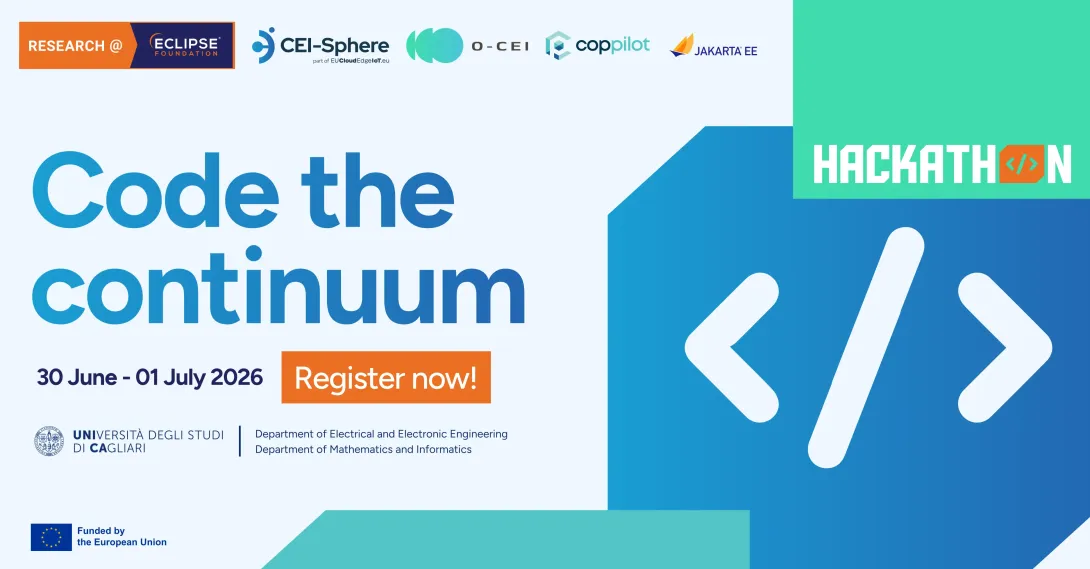
Code the Continuum
30 June – 01 July 2026
A two-day hackathon hosted by the University of Cagliari and organised by CEI-Sphere, O-CEI and COP-PILOT.
Code the Continuum brings together students, developers, researchers, innovators, open-source communities, pilot teams and solution providers for two days of hands-on collaboration around the cloud-edge-IoT continuum.
The event creates a practical space for experimentation, co-creation and exchange, where participants will work on real challenges related to open technologies, interoperability and the reuse of assets across large-scale pilot environments.
What to expect
Participants will engage with challenge areas linked to key domains such as energy, mobility and industry. The final thematic focus and challenge tracks will be confirmed in a follow-up announcement.
Who should join
Students, developers, researchers, innovators, open-source contributors, pilot teams and solution providers interested in collaboration across the CEI ecosystem.
Why it matters
The hackathon supports open-source uptake, fosters interoperability and reuse, and helps turn ideas into scalable solutions for Europe’s computing continuum.
Before you join
- Location: University of Cagliari – Building 2, Floor 2, “LIDIA Multifunzionale” Room, Via Merello (see venue details)
- Languages: Onsite instructions and support will be provided in both English and Italian.
- Prizes: The Hackathon includes awards for each of the three challenges tracks, with a total of €4,500 in prizes to be awarded across the event. For every track, the following awards will be granted:
- 1st Place - €750
- 2nd Place - €450
- 3rd Place - €300
- Registration deadline: 23 June 2026 at 17:00 CEST.
- Included: Coffee breaks and lunches for both days of the hackathon.
- More information: Additional practical details and final updates will be shared with registered participants in the coming weeks.
Beyond the prizes
In addition to competing for a share of the €4,500 prize pool, participants may gain visibility, mentorship opportunities and valuable connections with organisations working at the forefront of AI, cloud-edge computing and emerging digital infrastructures.
CeADAR – Ireland's Centre for Applied AI 🇮🇪
Selected winning teams will gain increased visibility within CeADAR, Ireland's Centre for Applied AI.
Outstanding participants may be identified as potential candidates for future collaborations or career opportunities, subject to standard University College Dublin recruitment processes and the availability of suitable positions.
Parsimoni – From the Continuum to Space 🚀
Code the Continuum is your chance to build an application that Parsimoni could help take all the way to a real satellite in orbit.
Selected winning teams may be invited to continue developing their solutions through a mentorship programme with Parsimoni, a French space technology startup. Participants will have the opportunity to explore how their ideas could be adapted for satellite and in-orbit applications, taking their solutions one step closer to real-world deployment.
O-CEI: Eclipse Zenoh & Sustainable Edge-Cloud
Participants will explore how Eclipse Zenoh can support energy-aware edge-cloud applications by comparing “cloud-only” and “edge-accelerated” deployments. Through hands-on experimentation, they will measure how optimising data flows across the continuum can reduce bandwidth usage and contribute to lower energy consumption.
- Concrete scenarios: Challenge 1.A: Distributed image processing with Zenoh, comparing cloud vs edge execution. Challenge 1.B: Geo-distributed content delivery using Zenoh and SkyFlok, comparing traffic across edge and cloud.
- Task: Install Zenoh client libraries (e.g. Python or Rust), run demo repositories, adapt them with your own data, and compare edge vs cloud configurations.
- Inputs: Example source code and demo repositories (GitHub).
- Expected demo (Definition of Done): At least one scenario running successfully, with visible Zenoh message exchanges and a short explanation of results.
- Skills: Programming (Python, Rust, C/C++), basic networking and distributed systems knowledge.
- Requirements: Laptop (Windows, Ubuntu or macOS) capable of running Zenoh demos and installing development tools.
- Mentors: Software engineers from ZettaScale.
COP-PILOT: From Code to Continuum: Orchestrating Distributed Applications with OpenSlice
Participants will use OpenSlice to orchestrate a small distributed energy application across a simulated cloud-edge environment. The challenge focuses on connecting 2-3 containerised services, such as energy data generation, processing or optimisation, and visualisation, to show how energy applications can be deployed and managed across the computing continuum.
- Concrete scenario: Orchestrate an energy monitoring pipeline across simulated edge and cloud domains
- Task: Build 2-3 containerised services and use OpenSlice to onboard, deploy, and manage them on a local Kubernetes environment.
- Inputs: OpenSlice documentation, Kubernetes deployment guidance, energy monitoring pipeline concept, and mentor support.
- Expected demo (Definition of Done): A runnable local deployment showing OpenSlice orchestrating the services of the distributed energy application.
- Skills: Kubernetes, Docker/containerisation, service orchestration, APIs, cloud-edge concepts, and general software development.
- Requirements: Laptop with a Linux-compatible setup, such as Linux, WSL2, or macOS, meeting OpenSlice’s recommended hardware requirements.
- Mentor: Lefteris Mylonas and Michail Tzanatos, COP-PILOT / OpenSlice technical representative.
ECLIPSE FOUNDATION: Jakarta EE, AI & the Hourglass Model
Proposed by the Eclipse Foundation, this challenge invites participants to design and implement a Jakarta EE application that models and analyses enterprise domains using the Hourglass Model. The mapping will be supported by an external Large Language Model (LLM), integrated through modern AI engineering and agentic techniques.
- Concrete scenario: Generate the Hourglass Model for a given domain and use case.
- Task: Design and implement a Jakarta EE application that models and analyses enterprise domains using the Hourglass Model, supported by an external LLM and agentic tools.
- Inputs: Skeleton project, OpenAI API key, starter guides and links to relevant resources.
- Expected demo (Definition of Done): A complete, runnable Jakarta EE project.
- Skills: Java, Maven and general knowledge of agentic AI techniques.
- Mentor: Ivar Grimstad, Jakarta EE Developer Advocate, Eclipse Foundation.