How can Europe's future energy infrastructure remain reliable, sustainable and resilient in a world increasingly shaped by digital technologies?
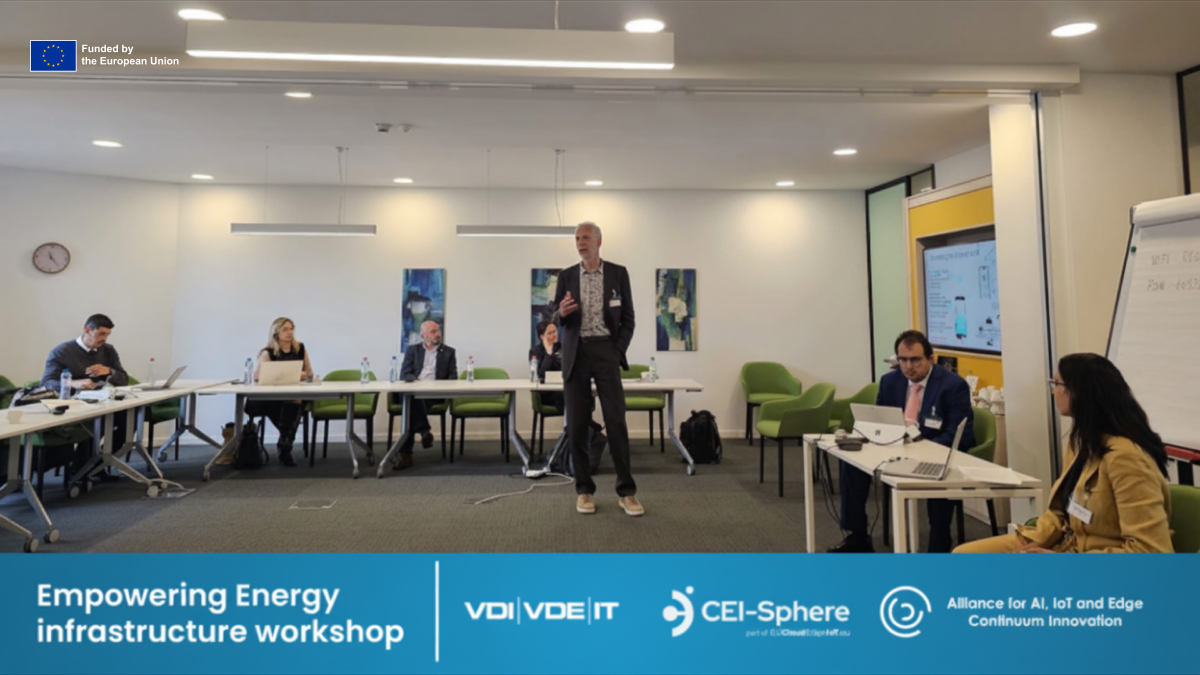
This question was at the centre of the Empowering Energy Infrastructure Workshop, organised by CEI-Sphere together with AIOTI and VDI/VDE-IT in Brussels. The event brought together experts from industry, research, telecommunications and energy sectors to discuss one of the key findings emerging from a recently published report on the convergence between energy systems and 6G technologies.
The discussion revolved around the AIOTI White Paper on Energy–6G Convergence, developed jointly with the 6G Smart Networks and Services Industry Association (6G-IA). The report examines how next-generation connectivity technologies could support the transformation of Europe's energy systems, while also highlighting the technical, operational and regulatory challenges that still need to be addressed.
Energy systems are becoming increasingly connected
Europe's energy infrastructure is undergoing a profound transformation. Distributed energy resources such as rooftop solar panels, electric vehicles, batteries and heat pumps are becoming an increasingly important part of the energy landscape. While these technologies bring new flexibility and sustainability opportunities, they also generate unprecedented levels of complexity.
Managing millions of connected devices requires far more than traditional grid management approaches. Energy systems increasingly depend on continuous communication, real-time data processing and coordination across multiple actors and infrastructures.
This is where advanced connectivity technologies become critical.
According to the report, future 6G networks could provide capabilities particularly relevant for energy applications, including ultra-reliable communications, integrated sensing, AI-enabled network management and support for massive numbers of connected devices. Rather than serving solely as communication networks, future infrastructures may become active components of the energy system itself.
However, the report also emphasises that technological capability alone is not sufficient.
Trust remains the central challenge
One of the report's strongest messages is that future connectivity infrastructures must earn the trust of the energy sector before they can support mission-critical operations.
Energy infrastructures typically operate over decades, while telecommunications technologies evolve much more rapidly. Integrating the two therefore requires careful planning, rigorous testing and a gradual deployment approach.
The report identifies three fundamental prerequisites for adoption:
- Security
- Observability
- Sustainability
Without clear evidence that these requirements can be met, large-scale deployment in critical energy environments will remain difficult.
The workshop discussions reinforced this point. Participants highlighted growing concerns around cybersecurity, the governance of AI-enabled systems and the protection of sensitive operational data. As energy systems become increasingly digital, resilience and trust must be considered from the outset rather than added later.
The importance of interoperability
A recurring theme throughout both the report and the workshop was interoperability.
While many technical standards already exist across telecommunications, IoT, cloud and energy domains, participants agreed that the main challenge is often not the absence of standards, but their fragmented implementation.
Future energy ecosystems will require devices, platforms, operators and services to exchange information seamlessly across organisational and national boundaries. This involves not only technical interoperability, but also common governance models, shared data semantics and aligned regulatory frameworks.
Several speakers highlighted the need for greater collaboration between the energy, telecommunications and digital infrastructure communities to avoid creating isolated solutions that cannot scale beyond individual projects or markets.
From pilots to deployment
The report also explores how emerging technologies such as Network Digital Twins can support the safe introduction of new capabilities into operational environments.
By creating virtual representations of complex infrastructures, operators can test scenarios, validate configurations and assess the impact of AI-driven decisions before applying them to live systems. This approach is particularly valuable in sectors such as energy, where reliability requirements leave little room for experimentation in production environments.
More broadly, the report argues that the transition towards connected energy systems should follow a progressive path: first improving monitoring capabilities, then introducing optimisation mechanisms, and only later moving towards fully automated and safety-critical control functions.
Building the foundation for Europe's energy future
The workshop formed part of CEI-Sphere's broader work on connecting technology providers, large-scale pilots, industry stakeholders and early adopters around shared challenges in the Cloud-Edge-IoT ecosystem.
While discussions covered a wide range of topics, the overall conclusion was clear: the future of energy infrastructure will depend not only on advances in connectivity technologies, but also on the ability to build trusted, interoperable and scalable ecosystems around them.
The AIOTI White Paper provides an important contribution to this conversation by offering a realistic assessment of both the opportunities and the challenges ahead. Rather than presenting 6G as a standalone solution, it positions advanced connectivity as one element of a much broader transformation that spans energy systems, digital infrastructures, standards, governance and market adoption.
As Europe continues to invest in both clean energy and next-generation digital infrastructures, the convergence of these domains will become increasingly important. The challenge now is to ensure that technological innovation translates into solutions that can be trusted, adopted and deployed at scale.
The AIOTI White Paper on Energy–6G Convergence and the workshop materials are available for consultation HERE.