
Rolf Riemenschneider
European Commission, DG Connect
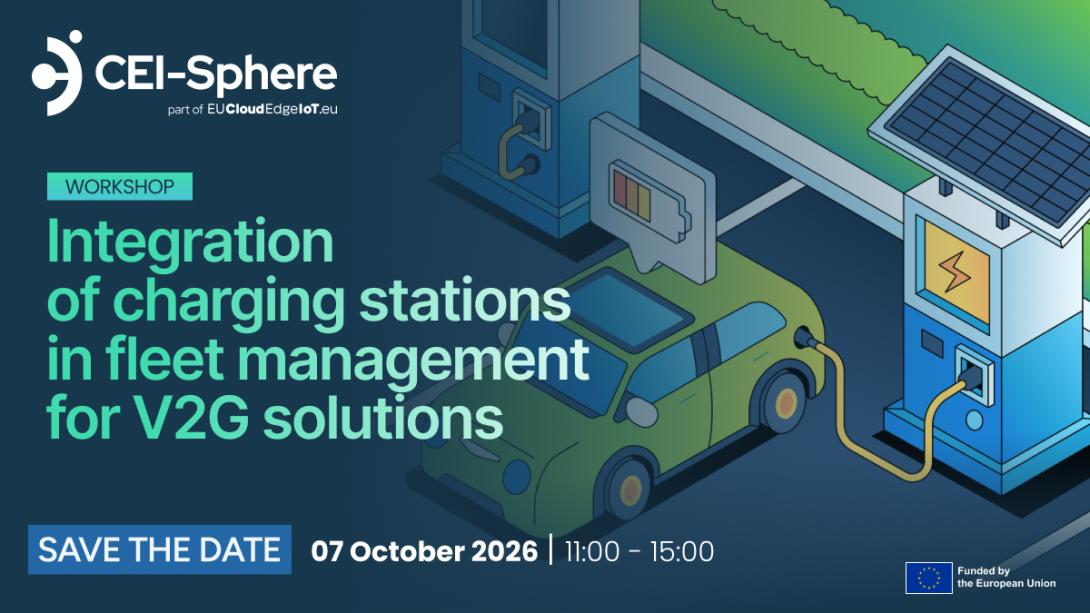
Depot charging plays a crucial role in fleet management in providing flexibility to the grid by integrating light and heavy duty vehicles (HDV) at central locations like depots, warehouses, or fleet yards. More than 80% of charging takes place outside public charging infrastructures. The approach allows fleets to provide flexibility to the grid when off duty, but ensuring vehicles are fully charged and road-ready when needed. The operational patterns also make fleets ideal candidates for the deployment of smart charging (V1G) and of vehicle to-grid (V2G), vehicle-to-building (V2B) or vehicle-to-everything (V2X) technologies.
Beyond simply connecting vehicles to the grid, charging stations are evolving into intelligent, interconnected assets that exchange data in real time, support new energy services, and contribute to more flexible and sustainable energy systems. To adapt and realise system efficiencies, fleet managers need to become more responsive to changes in demand and supply and more integrating variable renewable generation assets as well as batteries. This trend involves adopting platform-based business models, partnering strategically with aggregators, flexibility providers or manufacturers of charge stations, and mastering edge computing for advanced dynamic and decentralised management.
The workshop will address the implementation of a digital platform being at the heart of the V2G management, creating a real-time operational nervous system that connects key aspects of utility operations like flexible capacity management, demand-response, voltage control etc. with operational targets of the fleet, which could become a complex task.
The workshop will be introduced by an overview of V2G initiatives linked to the HE pilots on IoT Platforms and Decentralised Edge Intelligence as well as the European Coalition of the Willing on Bi-Directional Charging, established by Germany. The presented V2X scenarios could treat a fleet of EVs as a huge battery that can help balance grid load, even provide emergency power during outages due to grid saturation, damage through extreme weather conditions or sabotage.
The prime objective of the workshop is to discuss evolving Charging Station Management Systems. Emerging software-defined charging station utilizes software to manage and control its operations, which allows for greater flexibility, scalability, and efficiency in the charging process as well as the openness to third-party services. Such a software-defined framework gives a variety of advantages such as standardised communication interfaces, enabling data sharing across the value chain and a refinement of device functions over the stations’s lifecycle.
The workshop will also address the usage of the hourglass model as the basis for strategic industrial cooperation in AI and data processing across the cloud-edge continuum, in order to support open platforms, agreement on common architectures and standards, which is essential critical to establishing a vibrant European ecosystem.
The workshop will feature manufacturer pitches from Easee, go-e and Alpitronic, followed by a panel discussion on software-defined charging stations and future partnership models with charging-station manufacturers. The discussion will also include contributions from AMPECO and Pionix, the company behind the open-source EVerest platform.
11:00 - 11:10
11:10 - 11:20

11:20 - 11:30

11:30 - 11:45

11:45 - 12:00

12:30 - 13:30
13:00 - 15:05

Moderator
Moderator

Speaker
Speaker

Speaker

Speaker

Speaker

Speaker
Speaker
15:05 - 15:15