The Industrial Optimisation and Productivity Sphere targets industrial environments, improving efficiency, automation, and productivity through CEI technologies.
Industrial Optimisation and Productivity Sphere — Activities in Cycle 1
The Industrial Optimisation and Productivity Sphere launched its first cycle by bringing together participants working on industrial edge-to-cloud challenges, with a particular focus on how Cloud-Edge-IoT (CEI) solutions can support productivity, interoperability, trust, and scalable adoption in real industrial environments. A significant outcome of the cycle was the active involvement of additional industrial stakeholders, including experts from the Edge to Cloud Continuum (E2CC) focus group of the INSIDE Industry Association, which strengthened the Sphere with direct industrial and community-based expertise.
Stand-up #2: Sphere Kick-off
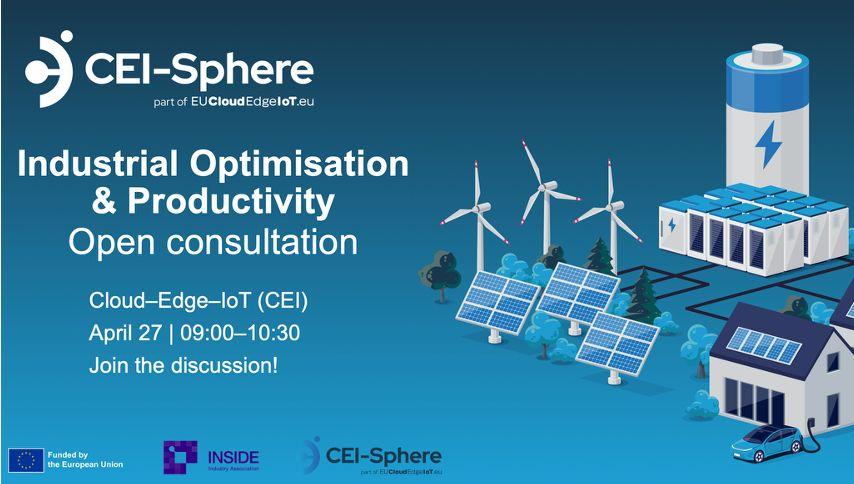
Stand-up #2, held on 27 April 2026, was the official kick-off of the Sphere. The highly-participated meeting saw a lively discussion converge around a shared technical challenge: enabling industrial edge-to-cloud ecosystems to integrate legacy and existing systems while preserving operational continuity. Participants highlighted that many industrial environments still rely on proprietary operational technologies, closed vendor ecosystems, and fragmented data silos. This makes it difficult to unlock value from existing infrastructures, reuse industrial data, and deploy advanced AI-enabled services across the edge-to-cloud continuum.
The Stand-up discussion also clarified that interoperability is not limited to device connectivity or protocol translation. At system-of-systems level, industrial CEI platforms need common abstractions for data interoperability, semantic alignment, trust management, orchestration, and policy enforcement. The group therefore framed the edge-to-cloud continuum as a practical industrial architecture challenge rather than a generic technology label: CEI solutions should help progressively integrate current industrial systems through appropriate interfaces, reusable building blocks, and secure governance mechanisms.
Deep Dive #1: Interactive Community Validation
The first deep-dive session, held on 27 May 2026, built on this challenge definition through a Wooclap-based interactive discussion with 24 questions covering legacy integration, interoperability, data management and sharing, regulation, security and trust, and future technological directions. The session produced a rich set of community inputs that validated and sharpened the priorities identified during the Stand-up.
The Wooclap results showed a consistent picture. Vendor lock-in and closed ecosystems were identified as the main obstacle to legacy integration (56%), while open standards and APIs ranked as the strongest enabler (260 points), followed by AI-driven interoperability tools (222 points). At system-of-systems level, participants prioritised coordination/orchestration (215 points), data interoperability (195 points), and semantic alignment (158 points). For trusted industrial data spaces, data sovereignty (171 points) and trust frameworks (156 points) ranked highest. Regulation was seen as most influential on data governance and cybersecurity, and future CEI platforms were expected to embed built-in cybersecurity, compliance-by-design, traceability, and adaptability to changing regulation.
On future technological directions, the discussion highlighted AI-driven orchestration, Edge AI, distributed intelligence, and federated data sharing as key enablers for industrial CEI ecosystems. Distributed orchestration ranked as the most important technological enabler (190 points), while participants linked the value of the edge-to-cloud continuum to concrete use cases such as smart manufacturing, predictive maintenance, critical infrastructure management, Industry 5.0 shop-floor scenarios, smart agriculture, energy coordination, and anomaly detection at the edge.
“The edge-to-cloud continuum represents a unified digital infrastructure where computing resources, applications, and services operate transparently from the edge to the cloud.”
A key takeaway from Cycle 1 is that the industrial CEI challenge is both technical and organisational. Participants consistently connected interoperability with governance, sovereignty, business incentives, regulatory implementation, and trust between independent stakeholders. The Sphere therefore provides a valuable space where CEI-Sphere can test common architectural requirements against practical industrial concerns.
By involving the INSIDE E2CC community and using interactive methods to collect structured input, the Sphere has created a strong foundation for the next cycle and for future work on legacy integration patterns, open standards and APIs, distributed orchestration, trusted industrial data spaces, and compliance-by-design approaches.